The Fed Just Moved.
Your Exit Is Already Set.
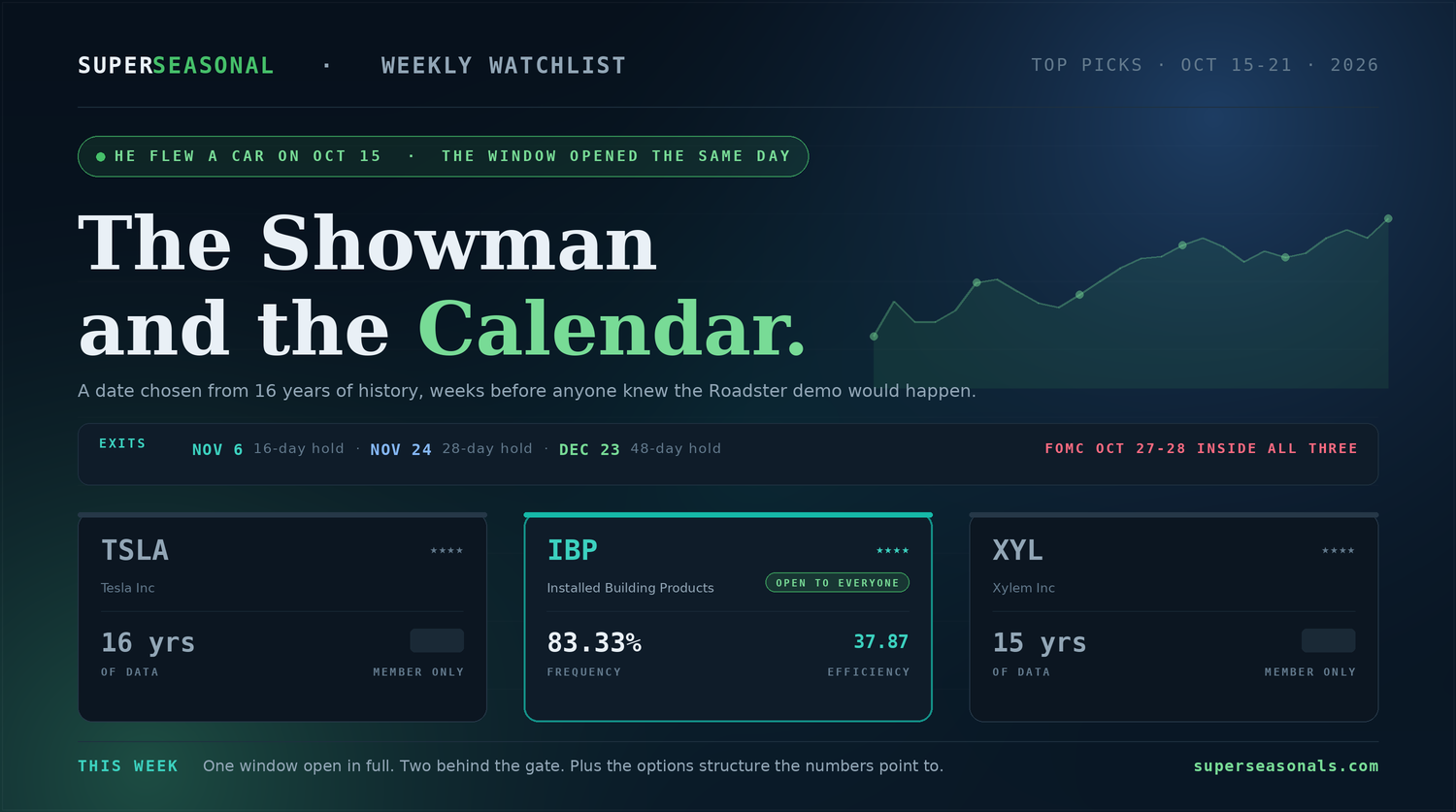
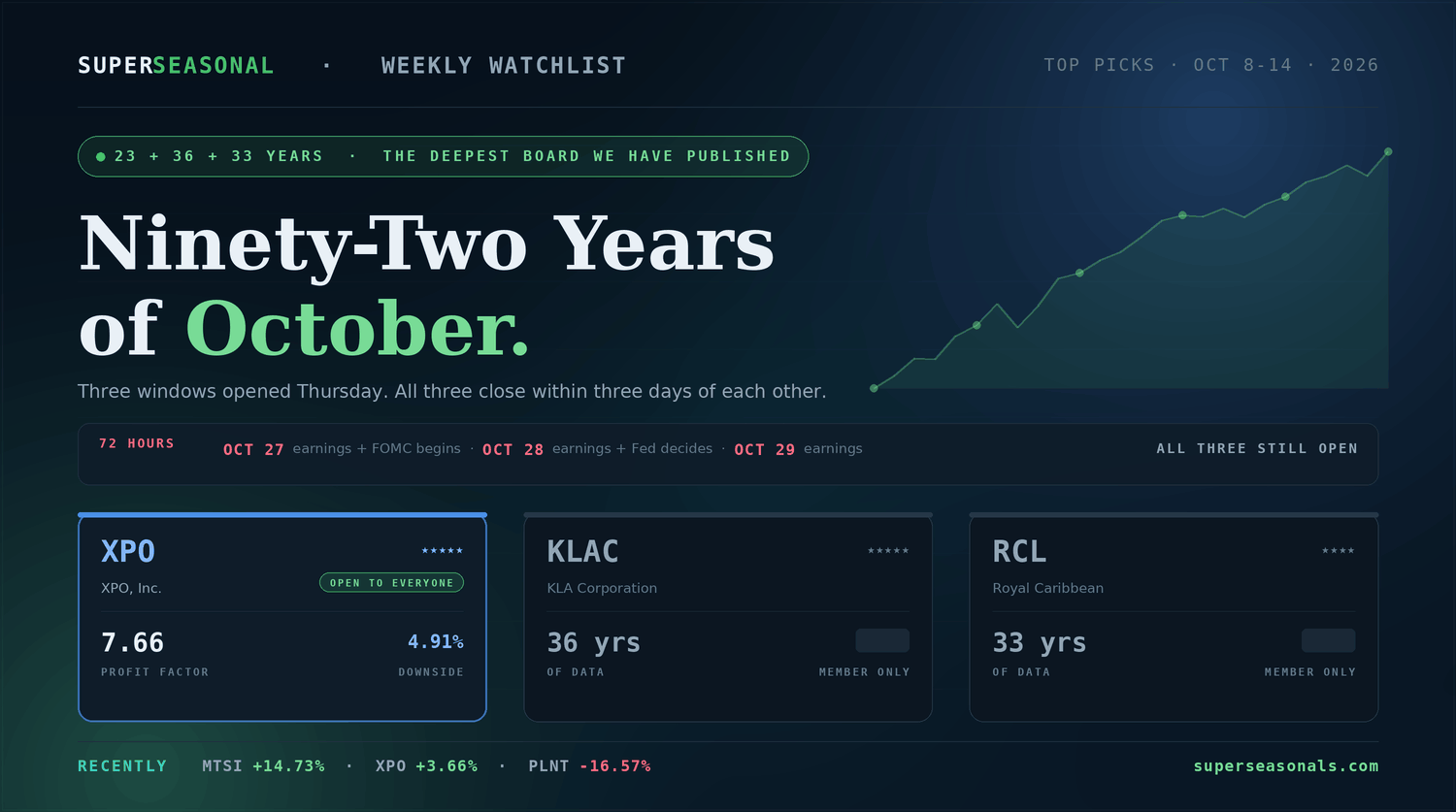
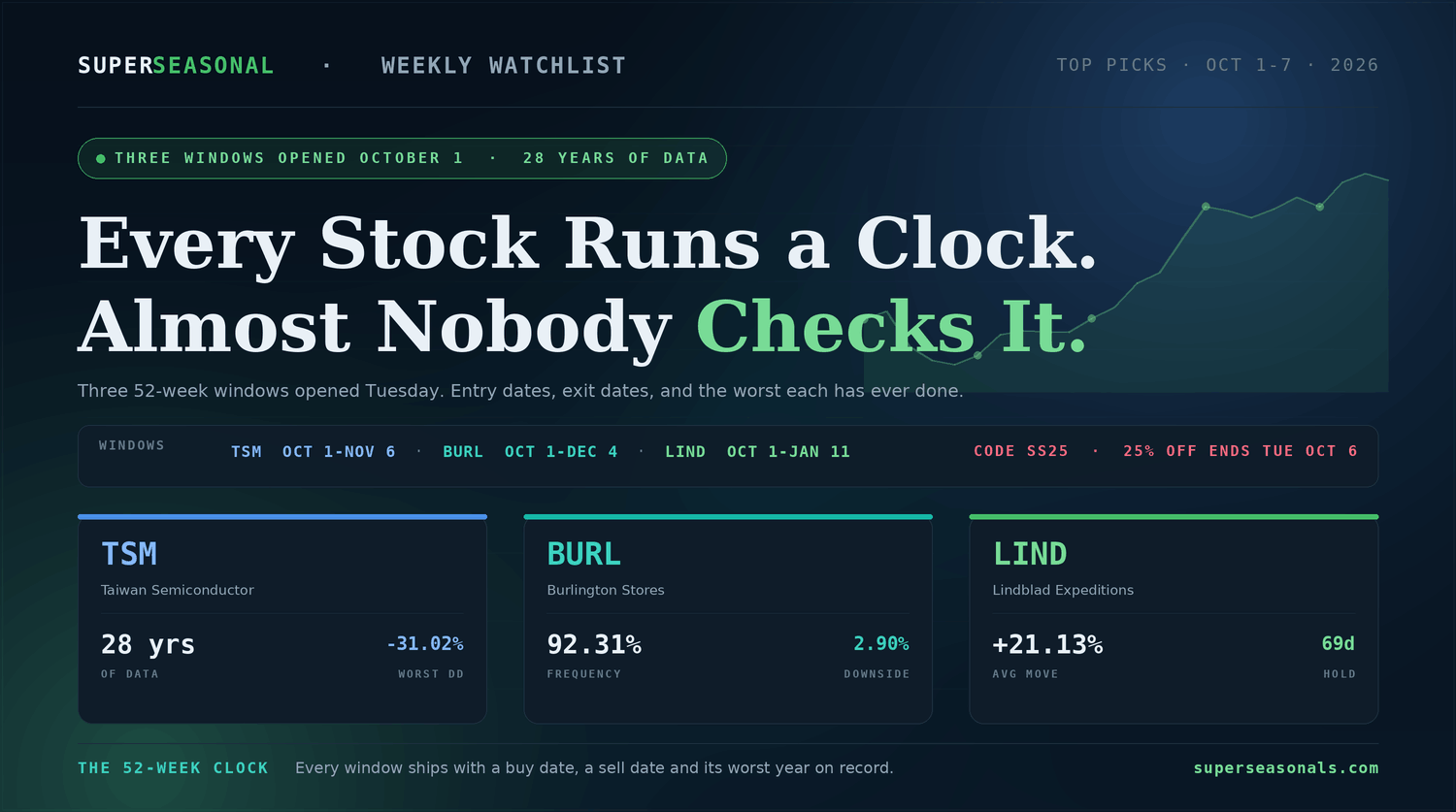
Trade Window: Aug 24 – Sep 15 · NTRA · TVTX · TSLA
Chair Warsh said the Fed still has “work to do” on inflation this morning, and September hike odds jumped to roughly even[cite: 6]. This week's window closes September 15 — the day before the FOMC decides.[cite: 6]
“Work to do” — and the market heard it
Chair Kevin Warsh delivered his first Jackson Hole keynote this morning, marking his hundredth day in the job[cite: 6]. He said he was impressed with the economy's overall strength but troubled that underlying inflation trends have not improved — and that the Fed will “have work to do” if policymakers are not confident inflation is returning to the 2% target[cite: 6]. It is the closest he has come to conceding that rate hikes may be needed[cite: 6].
He also doubled down on the approach that has frustrated markets since May: less explicit forward guidance, and a deliberately quieter Fed.[cite: 6] BMO's Vail Hartman called it a deliberately hawkish speech that should put to rest any doubt about the Fed's willingness to raise rates to restore price stability[cite: 6]. Warsh separately described AI as a “hinge point” for growth, invoking a hyper-Moore's law[cite: 6].
The repricing was immediate and one-directional[cite: 6]. Short-dated Treasuries sold off, with the 2-year yield jumping 6.6 basis points to 4.29%, its highest in a month, while the 30-year edged lower — a sharp flattening that says the market now expects tightening sooner rather than later[cite: 6]. Prediction markets moved in lockstep: Kalshi to 48%, Polymarket to 49%, CME futures from 35% Thursday to the mid-40s and higher[cite: 6]. September is now a coin flip[cite: 6].
Here is why the structure of this week matters more than usual[cite: 6]. This window runs August 24 to September 15. The FOMC announces on September 16.[cite: 6] The pattern closes the day before the decision — so whatever the committee does with a newly live hike on the table, this trade is designed to be finished before the gavel comes down[cite: 6]. You are not holding into the binary[cite: 6].
A sleeker Super Seasonal, with the analysis fully opened up.
You told us the setups were strong but you wanted to see more of the work behind them[cite: 6]. So every pick now ships with the complete measurement set — not just the headline numbers, but the ones that tell you what happens when a pattern fails[cite: 6].
Two Workshops. One Complete Picture.
This watchlist tells you when the calendar has historically been on your side[cite: 6]. The September sessions are about how you structure what you do with it[cite: 6].
On September 9 you focus on the strategies themselves[cite: 6]. On September 14 it goes a step further — instead of looking at every trade individually, you learn how different trades can potentially work together, and how that changes the way you think about risk, consistency, profit potential and compounding[cite: 6].
The diagnostics compounder
NTRA is the most conservative profile of the three — an 81.82% frequency, a 7.16 profit factor and a 70.00% annual win rate across 11 years[cite: 6]. It leads no category[cite: 6]. What it offers instead is a moderate downside footprint: a 2.47% downside sigma and a worst closing drawdown of just over 10%[cite: 6].
Natera is a molecular diagnostics company built around Signatera, its personalised ctDNA test for detecting minimal residual disease and cancer recurrence, alongside Latitude, Altera, Empower and the Panorama prenatal franchise[cite: 6]. The second quarter, reported August 6, was exceptional: revenue of $752.8 million against a $661.2 million consensus, with over one million tests processed for a second consecutive quarter and roughly 38% revenue growth[cite: 6]. Gross margin improved to 65%, days sales outstanding fell to 57, and management raised full-year guidance to $2.85–$2.91 billion[cite: 6].
Regulatory momentum is compounding[cite: 6]. Signatera received approval from Japan's PMDA for colorectal cancer in the adjuvant setting — the first MRD test cleared by the PMDA in that indication — with commercial launch targeted through SRL's national lab network by end-2026, plus a further submission for muscle-invasive bladder cancer[cite: 6]. Targets followed: Citi $365, Piper Sandler $363.50, Guggenheim $360, Stephens $350, Barclays $340[cite: 6].
At roughly $340 the shares sit essentially at the $336.74 average analyst target — the upgrades have caught up to the price, a very different setup from buying a discount[cite: 6]. The stock ran from about $265 to over $322 in four sessions after earnings[cite: 6]. Natera also remains unprofitable, and several insiders, including executive chairman Matthew Rabinowitz and co-founder Jonathan Sheena, sold shares in August[cite: 6].
Diagnostics demand is not set by the funds rate — but after Friday's speech, an unprofitable high-multiple grower is squarely in the crosshairs of a repricing in rate expectations[cite: 6]. The business is insulated; the multiple is not[cite: 6]. Swing factors: Signatera volume, reimbursement and the Japan launch[cite: 6].
NTRA pairs the mildest downside profile here (2.47% sigma, worst drawdown -10.58%) with an outstanding quarter — a $91 million revenue beat, raised guidance and a first-of-its-kind Japanese approval[cite: 6]. The counterweight: it trades at the average analyst target after a violent post-earnings run, with insider selling in the tape[cite: 6].
The standout of the scan
This is the most striking row this newsletter has ever printed[cite: 6]. A 54.03 profit factor comfortably exceeds our previous record of 40.46, and a +218.45% annualized return leads everything on this week's list[cite: 6]. But the number deserving equal attention sits in the downside band: a 0.76% downside sigma, a worst year of just -2.64%, and a worst closing drawdown under 9% across 13 years[cite: 6].
That combination — enormous upside statistics alongside an unusually contained downside record — is what a 54.03 profit factor actually describes[cite: 6]. Historically the winning periods in this window have overwhelmed the losing ones, and the losing ones have been shallow[cite: 6]. It does not promise the pattern repeats[cite: 6]. It does mean the historical risk footprint has been remarkably tight for a biotech[cite: 6].
The business has changed character underneath it[cite: 6]. Travere is a San Diego rare-disease company whose kidney franchise has scaled fast: FILSPARI net product sales reached $141.1 million in the second quarter, up about 96% year-over-year, within total revenue of $169.6 million that beat the $159.6 million consensus[cite: 6]. Management cited record demand and more than 2,000 new patient start forms across IgA nephropathy and the newer FSGS launch[cite: 6]. Cash and marketable securities stood at $489.2 million[cite: 6].
Travere presents at the Wells Fargo Healthcare Conference on September 8 and the Citi Biopharma Back to School Conference on September 9 — both inside this trade window[cite: 6]. The August 4 print triggered a wave of target increases: Citi to $85, Wedbush to $75, Canaccord to $70, BofA to $64[cite: 6]. The stock has gained roughly 236% over twelve months and trades near the top of its range[cite: 6].
Travere is still lossmaking[cite: 6]. The second quarter carried a GAAP net loss of $34.8 million, widened by a $40 million charge tied to convertible note repurchases, and total debt has been reported near $617 million[cite: 6]. Single-product concentration in FILSPARI means any reimbursement, competitive or regulatory setback lands hard[cite: 6]. A 54.03 profit factor describes history, not a floor[cite: 6].
Rare-disease revenue is about as insulated from the Fed as equities get — but an unprofitable, high-beta biotech still reprices on risk appetite, and Friday's hawkish turn tightens that screw[cite: 6]. The swing factors remain FILSPARI uptake and the September conference circuit, both of which sit inside the window[cite: 6].
TVTX is the standout: a 54.03 profit factor and +218.45% annualized return, paired with the cleanest downside record on the list — 0.76% sigma, worst year -2.64%[cite: 6]. Underneath sits a genuinely inflecting franchise, with FILSPARI up 96% and two investor conferences inside the window[cite: 6]. The caveat is real: still lossmaking, meaningful debt, heavy reliance on a single drug[cite: 6].
The deepest history on the list
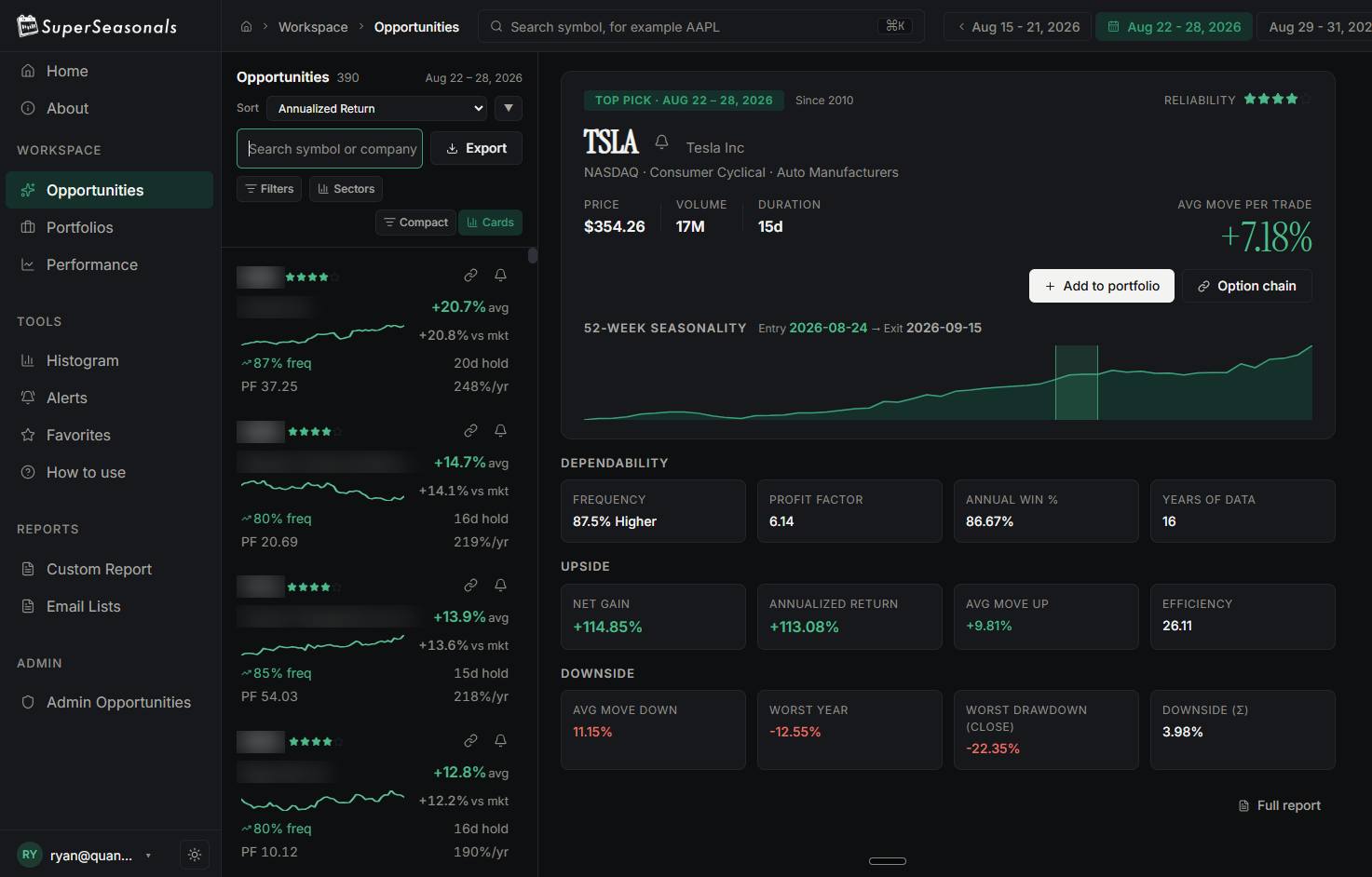
TSLA brings the deepest data set on the list — 16 years of history — along with the best frequency at 87.5% and the best annual win rate at 86.67%[cite: 6]. It also carries the roughest downside by a clear margin: an 11.15% average move down, a worst year of -12.55%, and a worst closing drawdown of -22.35%[cite: 6].
Read those two facts together, because they are the trade[cite: 6]. This window has worked more consistently than anything else here, across more years than anything else here — and when it has failed, it has hurt roughly twice as much as NTRA and five times as much as TVTX on a sigma basis[cite: 6]. A 3.98% downside sigma is not a reason to avoid it[cite: 6]. It is a reason to size it differently[cite: 6].
The company is in the middle of its most consequential transition[cite: 6]. Nevada cleared large robotaxi fleets in August, the Miami service extended the network beyond Texas and California, and the Cybercab launch in Austin is approaching[cite: 6]. Shanghai wholesale volumes reached 93,579 in July, up about 37.8% year-over-year and a ninth consecutive month of growth[cite: 6]. The balance sheet is strong, with roughly $43.5 billion of cash supporting a 2026 capital programme above $25 billion[cite: 6].
The autonomy story is advancing faster than the revenue is[cite: 6]. Musk has said material robotaxi revenue is unlikely before 2027, and prediction markets remain sceptical about a near-term California launch[cite: 6]. Meanwhile Tesla triggered its largest-ever recall over door handles, part of a 4.3 million vehicle action across eight automakers in China[cite: 6]. Energy revenue grew 13% but margins compressed from 30.3% to 20.4%[cite: 6].
The average analyst target sits near $397.94, implying modest upside from about $354, and Morgan Stanley holds Equal Weight at $415[cite: 6]. Gary Black has called the stock fully priced on a 2026 P/E above 200[cite: 6]. Shares sit well below the $498.83 52-week high set in June[cite: 6]. Add proposed 50% tariffs on Canadian cars and steel from 2027 — and a Fed chair who just pushed September hike odds to a coin flip — and this is the most exposed name on the list[cite: 6].
Tesla is the most rate-sensitive of the three: a very high multiple, a capital-intensive AI and robotics programme, and a consumer product financed by borrowers[cite: 6]. Friday's hawkish turn hits this name hardest of the three, and the 2-year yield jumping to a one-month high is the tell to watch[cite: 6].
TSLA offers the deepest track record on the list — 16 years, 87.5% frequency, an 86.67% win rate — on a company with genuine autonomy momentum in Nevada, Miami and Austin[cite: 6]. It is also the highest-variance name here by every downside measure we publish, with a -22.35% worst drawdown, a recall headline, a 200-plus multiple and the most sensitivity to a newly hawkish Fed[cite: 6].
The three setups, side by side
| Ticker | Freq. | Profit Factor | Annual Win % | Ann. Return | Worst Drawdown | Downside Σ | Years |
|---|---|---|---|---|---|---|---|
| NTRANatera | 81.82% | 7.16 | 70.00% | +86.47% | -10.58% | 2.47% | 11 |
| TVTXTravere Therapeutics | 84.62% | 54.03 | 76.92% | +218.45% | -8.80% | 0.76% | 13 |
| TSLATesla | 87.5% | 6.14 | 86.67% | +113.08% | -22.35% | 3.98% | 16 |
Opportunity is easy to find. Calm conviction is the hard part.
This morning is the argument in miniature[cite: 6]. A twenty-minute speech moved September from a one-in-three chance to a coin flip, and every open-ended position in the market had to be rethought on the fly[cite: 6]. Ours did not. The exit date was set before the Chair reached the podium[cite: 6].
The goal was never to trade more[cite: 6]. It was to trade a smaller number of better-prepared ideas — and to spend the rest of the week not worrying about them[cite: 6].
Sign Up to View Full Trade DetailsThe Big Picture
Three setups, one window, three completely different risk footprints — and a defined exit before the Fed decides[cite: 6].
Friday changed the backdrop, not the plan[cite: 6]. A hawkish Warsh pressures every high-multiple name on this list — TSLA most, TVTX and NTRA through sentiment rather than through the business[cite: 6]. But notice how the downside band separates these three far more sharply than the upside band does[cite: 6]. On annualized return they span +86% to +218%; on downside sigma they span 0.76% to 3.98% — a fivefold spread[cite: 6]. That is the number that should drive your sizing into a newly uncertain September, and it is precisely the number most services never show you[cite: 6].
And the window does real work: entering August 24 and exiting September 15 puts the whole trade in front of the September 16 decision[cite: 6]. Seasonality gives you the roadmap, the new detail gives you the risk footprint, and the calendar gives you the exit — watch the price action, respect your stops, and let the plan do the worrying[cite: 6].
Sign Up to View Full Trade DetailsSuper Seasonal Trade Desk
Don't Stop With the Strategy. Learn How to Combine It.
Attending the September 9 Strategy Workshop? You can add the LIVE Cash Flow Combination Workshop on September 14 and go from trading setups one at a time to thinking about how multiple positions can work as one[cite: 6].
The idea behind Profit Stacking: if a trade carries $3,000 of risk and a properly structured combination reduces that exposure to $1,000 while attempting to preserve the original profit potential, you have potentially freed up $2,000 of risk you were already willing to take — capital you may be able to deploy into another quality opportunity[cite: 6].
Attendee-exclusive pricing. Examples shown are illustrative of the concepts taught and are not a projection of results; combining option positions involves risk, including the risk of loss. Nothing here is personalized financial advice.[cite: 6]