Next Week Is Loud.
Your Plan Shouldn't Be.
Week of September 8 · GRPN · NVMI · TFIN
A month ago a September hike was a one-in-three long shot. It is now the market's base case at roughly 66%[cite: 9]. Five days, four market-moving events, and three setups that were picked before any of it made the news[cite: 9].
Two Workshops. Six Days Apart. Then the Fed Speaks.
The calendar did something unusual this September: the two live sessions land inside the same week the market gets its last inflation print before a likely rate hike.[cite: 9] Learn the strategy on the 9th[cite: 9]. Learn how to combine it on the 14th[cite: 9]. Watch the Fed move on the 16th[cite: 9].
Two ideas anchor the second session.[cite: 9] PPD Arbitrage — what emerges when you combine trades across different expirations[cite: 9]. And Profit Stacking — structuring a combination to cut exposure while attempting to preserve the profit potential you started with[cite: 9].
That is a 70% discount off the final price as the workshop draws closer[cite: 9].
Reserve Your Seat NowFrom long shot to base case in six days
Watch the whole arc, because it is a lesson in how fast a narrative flips[cite: 9]. A month ago, September hike odds sat near 67%[cite: 9]. Then July payrolls came in negative and the odds collapsed to roughly 36%[cite: 9]. Then Warsh took the Jackson Hole podium on August 28, said the Fed still has “work to do,” and the odds doubled back to around 66%[cite: 9]. One analyst tracking it called the move a full round trip[cite: 9].
What tipped it was the inflation gauge Warsh himself keeps pointing at: PCE running near 3.7% over twelve months and 4.1% over six — not just above the 2% target, but accelerating underneath[cite: 9]. The 10-year yield pushed to about 4.79%, its highest since January 2025[cite: 9]. Barclays now expects two more hikes this year, September and December[cite: 9].
Here is the honest headline about this week's scan, and we would rather say it than bury it.[cite: 9] All three names carry win rates between 64% and 73% — noticeably lower than the 80%-plus profiles we have been running[cite: 9]. Two of them pair that with profit factors near 15[cite: 9].
That combination has a specific meaning: bigger payoffs, landed less often.[cite: 9] These are slugger setups, not metronomes[cite: 9]. It does not make them worse trades[cite: 9]. It makes them differently sized trades — and knowing which kind you are holding before you enter is most of the job[cite: 9].
Same edge. Far more of the truth.
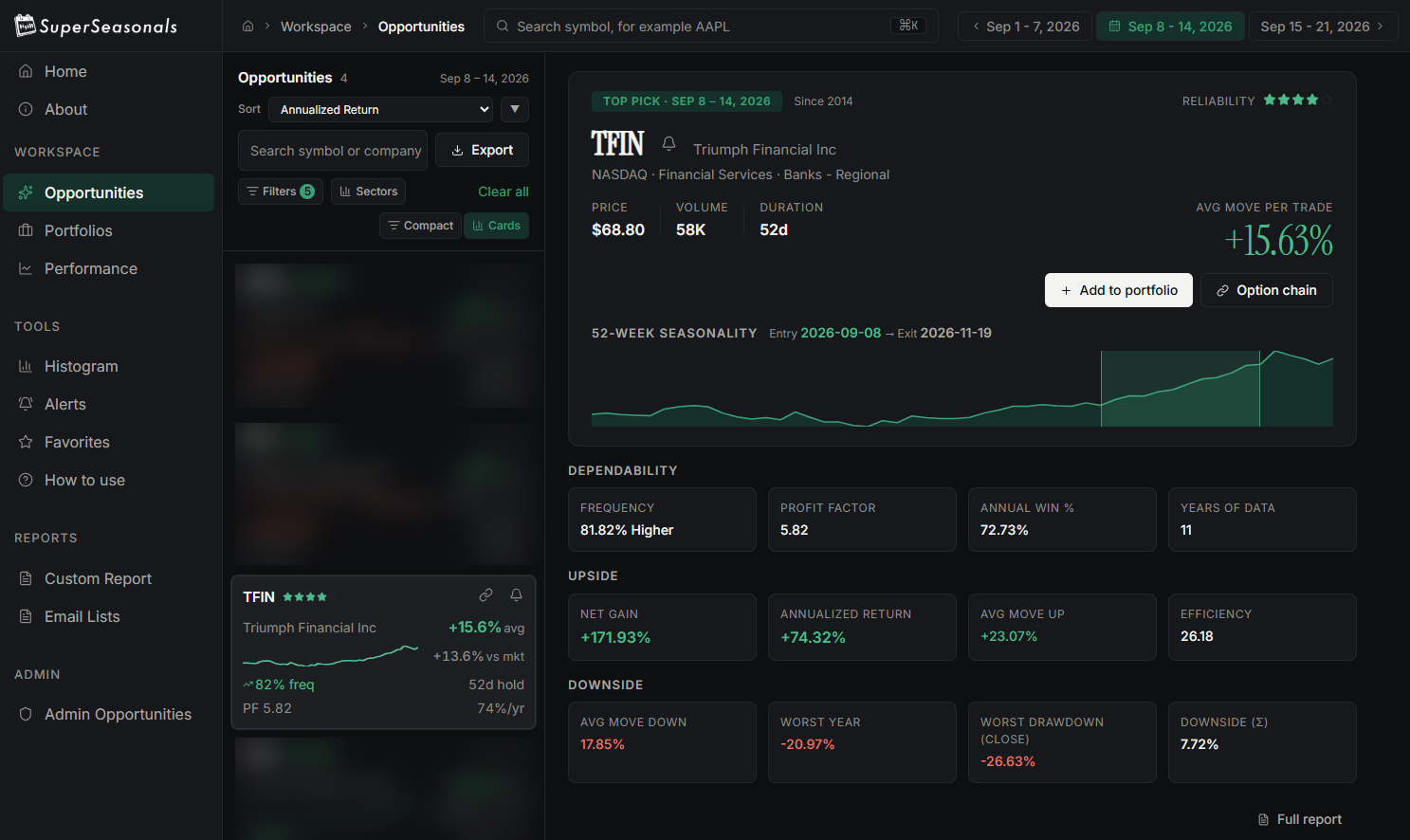
The old format gave you four numbers[cite: 9]. The new Super Seasonal gives you twelve, split into dependability, upside and downside — including the worst year and the worst drawdown on record[cite: 9]. TFIN below is our showcase this week, published in full so you can see exactly what changed[cite: 9].
The comeback nobody scripted
Yes, that Groupon[cite: 9]. And before you scroll past: this window carries the highest frequency (85.71%) and the highest annualized return (+106.15%) on the list, with a 14.84 profit factor[cite: 9]. It also carries a 64.29% annual win rate — the lowest we have printed in months.[cite: 9]
Read those two numbers together, because they are the entire personality of this trade[cite: 9]. A big profit factor next to a middling win rate means one thing: when it works it works enormously, and it works less often than you would like.[cite: 9] This is not a metronome[cite: 9]. It is a slugger with a high strikeout rate[cite: 9].
The business is a genuine turnaround-in-progress[cite: 9]. Q2 revenue of $124.7 million was roughly flat year-over-year, and the company is still lossmaking — but adjusted EBITDA came in at the top of guidance and free cash flow hit $15 million[cite: 9]. Management reaffirmed full-year revenue of $513–$523 million with adjusted EBITDA of $75–$80 million and free cash flow of at least $60 million[cite: 9]. The engine underneath is Project Foundry: an AI rebuild of the tech stack, a 20% headcount cut, AI voice agents pitching merchants, and Groupon IQ generating deals[cite: 9]. The CEO wants the company “AI fluent” by year end[cite: 9].
The stock is up roughly 123% over twelve months — and has given back about 27% in the last thirty days, to around $18.50[cite: 9]. That gap is the setup[cite: 9]. The three analysts covering it average a $36 target, roughly 91% above the recent price, and consensus now models a swing from a $1.51 per-share loss to $0.92 of profit next year[cite: 9].
Goldman Sachs raised its target to $22 — and kept a Sell rating[cite: 9]. Trailing twelve-month net loss sits near $125.5 million, and Q1 showed no tangible SG&A savings despite the cost programme[cite: 9]. At roughly 15.9x EV/EBITDA against Yelp near 5.7x, you are paying a premium for a turnaround that has not yet proven itself in the margin line[cite: 9]. Q3 free cash flow is guided negative[cite: 9].
GRPN is the boom-or-bust seat on this week's list: best frequency, best annualized return, a 14.84 profit factor — and the lowest win rate here by a nose[cite: 9]. The AI turnaround is real enough to have doubled the stock in a year and shaky enough that Goldman still says sell[cite: 9]. Size it like the slugger it is[cite: 9].
The pick-and-shovel AI trade
NVMI's profile is GRPN's near-twin: a big 14.25 profit factor and an 84% frequency, sitting on a 64% annual win rate — the lowest of the three[cite: 9]. Its +70.73% annualized return is the most modest here[cite: 9]. Same personality, calmer magnitude[cite: 9].
Nova is an Israeli company that makes optical and X-ray metrology systems — the machines that measure whether a chip has actually been built correctly, at scales where a rounding error is a scrapped wafer[cite: 9]. Every advanced logic node, every DRAM upgrade, every stack of advanced packaging needs more measurement, not less[cite: 9]. It is the toll booth on the AI build-out, and it does not need to pick which chip designer wins[cite: 9].
The numbers back the story[cite: 9]. First-quarter revenue of $235.3 million rose 10% and beat estimates by 3.7%; EPS of $2.18 beat by 2.7%; net income reached $69.3 million[cite: 9]. Full-year 2025 revenue landed at $880.6 million, and the company opened a Mannheim facility that triples its advanced-packaging metrology capacity[cite: 9]. The stock is up roughly 44% over twelve months[cite: 9].
Wall Street is stacked on the bull side: an average target near $597.63 implying about 22% upside, with Jefferies at $640, Evercore and Barclays at $600, and Citi at $595[cite: 9]. Eight analysts, Buy consensus[cite: 9].
Nova's own revenue is forecast to grow about 15% a year over the next three years — against roughly 22% for the US semiconductor industry.[cite: 9] That is a quality business growing slower than its sector, which is a valuation problem if the multiple already assumes leadership[cite: 9]. Morgan Stanley sits at Equal Weight with a $494 target, essentially flat to the price[cite: 9]. And Q1 profit margin slipped to 29% from 30% on higher expenses[cite: 9].
NVMI is the sober way to own the AI capex cycle: an essential measurement franchise with a beat-and-raise cadence and a $597 average target[cite: 9]. But it has the lowest win rate on the list, its forecast growth trails its own industry, and Morgan Stanley's Equal Weight sits right at the current price[cite: 9]. Quality, at a price that already knows it[cite: 9].
This week's showcase — the full readout
This is the one we put on the screenshot, and it is the one that best explains why the new platform matters[cite: 9]. TFIN has the best annual win rate on the list at 72.73% and a modest 5.82 profit factor[cite: 9]. Look one band lower and the picture completes itself[cite: 9].
A 7.72% downside sigma, a worst year of -20.97% and a worst closing drawdown of -26.63% — the roughest downside record we have ever printed[cite: 9]. Against that: a +171.93% net gain and a +23.07% average move up[cite: 9]. This trade wins more often than anything else here and hurts more when it loses[cite: 9]. Under the old four-stat format you would have seen the 72.73% and stopped[cite: 9]. Now you see the whole trade[cite: 9].
Triumph is not a normal bank[cite: 9]. It is a transportation-focused fintech — payments, factoring, banking and intelligence built for freight[cite: 9]. TBK Bank, LoadPay, the Triumph Network[cite: 9]. Its data touches roughly 70% of North American brokered freight and 170,000-plus carriers, and it has been turning that into product: RFP Manager for lane-level contract pricing, and Market Rate Intelligence now embedded inside PCS Software's TMS[cite: 9]. Q2 earnings surged on Factoring and Payments growth as the freight market rebounded[cite: 9].
The freight cycle is the whole thesis[cite: 9]. Triumph is a leveraged bet on trucking volumes recovering, and the recent quarter delivered exactly that[cite: 9]. D.A. Davidson lifted its target to $82 from $65, and a second desk moved to $82 from $70 — against a share price near $68.80 and a 52-week range of $46.43 to $83.52[cite: 9].
One: this is a 52-day hold running September 8 to November 19 — it runs straight through the September 16 Fed decision, October CPI, and Triumph's own October 21 earnings[cite: 9]. Unlike our recent 15-day windows, you are not out before the noise[cite: 9]. Two: those target raises came with Hold ratings attached; the consensus is neutral, not bullish[cite: 9]. Three: a P/E near 50 on a $1.76 billion small-cap bank, in a rate environment that just turned hostile[cite: 9].
A regional bank with a freight-cycle engine is genuinely two-sided here: higher-for-longer rates can widen net interest margin, but they also squeeze the small carriers and brokers Triumph finances[cite: 9]. With hike odds near 66% into a decision that lands inside this hold, TFIN is the name on this list most directly exposed to what the Fed does on the 16th[cite: 9].
Best win rate here (72.73%), a genuinely differentiated freight-fintech franchise, and fresh $82 targets against a $68.80 price[cite: 9]. But it carries the roughest downside record we publish — a -26.63% worst drawdown and 7.72% sigma — on a 52-day hold that spans the Fed, CPI and its own earnings[cite: 9]. High conviction, wide stops, small size[cite: 9].
The three, side by side
| Ticker | Frequency | Profit Factor | Ann. Return | Annual Win % | Personality |
|---|---|---|---|---|---|
| GRPNGroupon | 85.71% | 14.84 | +106.15% | 64.29% | Big swings, lower hit rate |
| NVMINova Ltd. | 84% | 14.25 | +70.73% | 64% | Same shape, calmer scale |
| TFINTriumph Financial | 81.82% | 5.82 | +74.32% | 72.73% | Most consistent, deepest drawdown |
The market gets loud. Your process shouldn't flinch.
In six days a single speech moved September from a long shot to a coin flip to the base case[cite: 9]. Everyone holding an open-ended position spent that week rewriting their thesis on the fly[cite: 9]. The dates on this week's picks were set before any of it happened.[cite: 9]
The goal was never to trade more[cite: 9]. It was to trade fewer, better-prepared ideas — and to spend the rest of the week not thinking about them[cite: 9].
Sign Up to View Full Trade DetailsThe Big Picture
One week, four events, three setups with three different jobs[cite: 9].
One structural note we will not soften[cite: 9]. Our last two issues closed before the FOMC[cite: 9]. This one does not.[cite: 9] TFIN's window runs September 8 to November 19 — straight through a likely rate hike, October's CPI, and Triumph's own October 21 earnings[cite: 9]. That is a longer, noisier hold than we have run in a month, and it is exactly why the downside band is printed in full beside it[cite: 9].
Two of these three win big and win less often[cite: 9]. One wins more often and falls harder[cite: 9]. None of them is wrong — they are just different tools, and the numbers tell you which is which before you commit a dollar[cite: 9]. That is the whole product in a sentence[cite: 9].
Sign Up to View Full Trade DetailsSuper Seasonal Trade Desk
Don't Stop at the Strategy. Learn to Combine It.
Here is the idea in one line[cite: 9]. A trade carries $3,000 of risk[cite: 9]. A properly structured combination reduces that exposure to $1,000 while attempting to preserve the original profit potential[cite: 9]. You have potentially freed up $2,000 of risk you were already willing to take — capital you may be able to deploy into another quality opportunity[cite: 9].
That is Profit Stacking, and it is the centrepiece of the September 14 session[cite: 9]. If you are already attending the Strategy Workshop on the 9th, you can add it now[cite: 9].
You are receiving this because of your involvement with SmartTrading — your participation level has earned the discount below[cite: 9]. When this workshop opens to the general trading public the cost will be $2,997, and as the seminar approaches that price goes to $4,997[cite: 9].
A 70% discount off the final price — but only until September 7th[cite: 9].
Reserve Your Seat NowAttendee-exclusive pricing. Examples shown are illustrative of the concepts taught and are not a projection of results; combining option positions involves risk, including the risk of loss. Nothing here is personalized financial advice.[cite: 9]