The Cycle Started.
Your Sizing Just Got Harder.
Week of September 22 · PLNT · NVDA · GNRC
Three entries on the same Tuesday — with downside sigma running from 3.99% to 14.45%[cite: 26]. Every number is below, including the ones that decide how much you put on[cite: 26].
“Too high … for too long”
The FOMC voted 12–0 to raise the federal funds rate a quarter point to 3.75%–4.00% — the first increase since 2023[cite: 26]. Chair Warsh said inflation has been “too high … for too long.”[cite: 26]
The dot plot is the part that matters[cite: 26]. Sixteen of eighteen participants expect at least one more hike this year, and four pencilled in two[cite: 26]. There are no cuts projected for 2027 at all, with the median holding near 4.1%[cite: 26]. Stocks fell on the guidance rather than the hike, and HSBC now expects another increase in December[cite: 26].
For nine months the question was whether the Fed would hike[cite: 26]. That question is now closed, and a different one replaces it: how many more, and how fast.[cite: 26] Sixteen of eighteen officials say at least one more this year[cite: 26]. No cuts at all in 2027[cite: 26]. That is a different regime for anything priced on future cash flows[cite: 26].
Which is why the spread on this week's board matters more than usual[cite: 26]. Downside sigma runs from 3.99% to 14.45% — a 3.6x range across three names entering on the same day.[cite: 26] One is nearly uncorrelated to the index[cite: 26]. One is the most rate-sensitive stock in the market[cite: 26]. Same week, three completely different amounts of risk[cite: 26].
The New Super Seasonal is live in your account.
Every pick on the board below now carries twelve statistics instead of four — dependability, upside and downside, including the worst year and the worst closing drawdown on record[cite: 26]. That third band is the one that decides position size, and it is the reason this week’s three names are sized so differently[cite: 26].
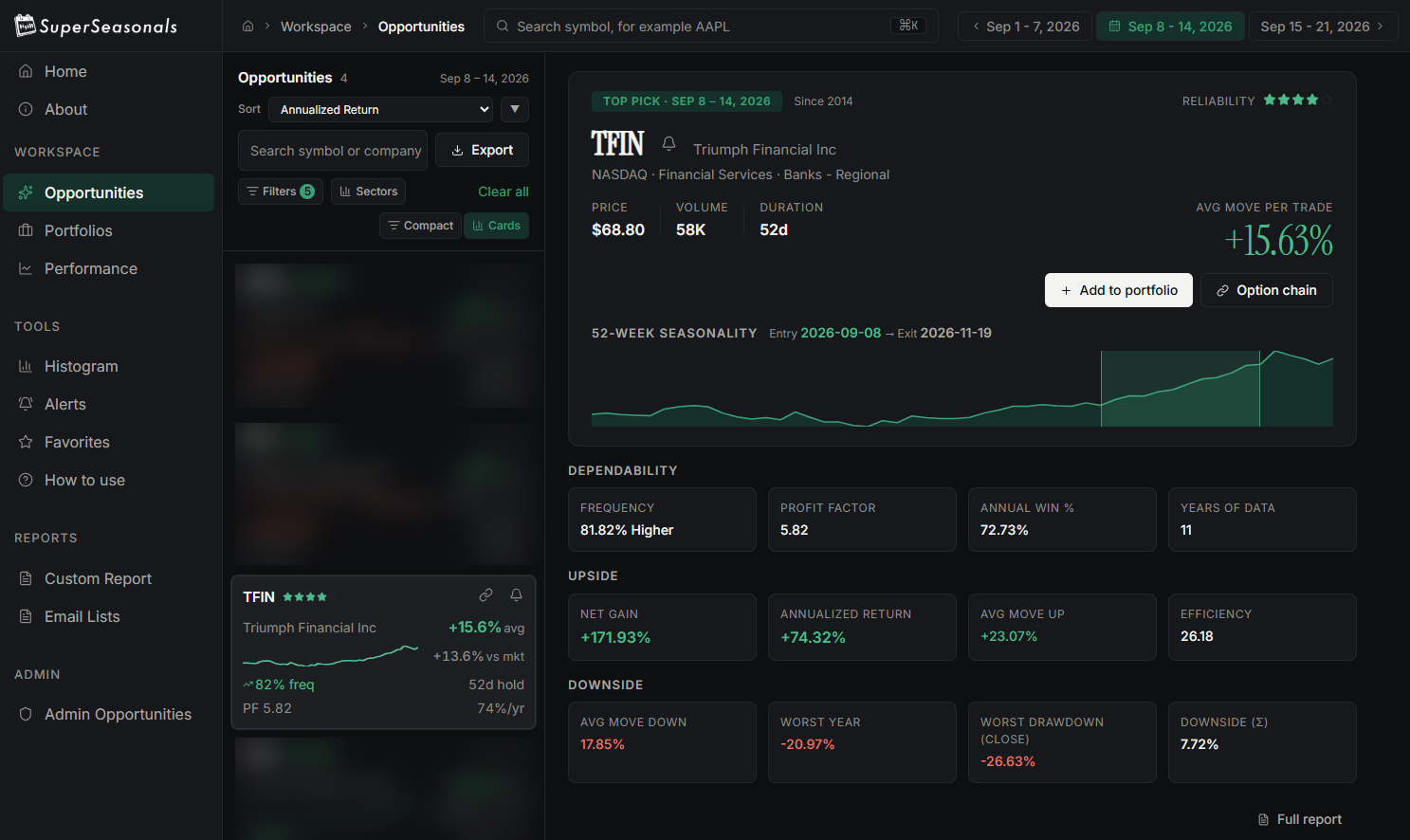
And you no longer have to come looking.[cite: 26] Set your Opportunity Filters once — reliability, profit factor, downside sigma, holding period, win rate — and Super Seasonal emails you the moment a setup matches[cite: 26]. Your criteria, your thresholds[cite: 26]. If nothing qualifies, you hear nothing[cite: 26].
Set Your Opportunity FiltersThe best risk-adjusted setup on the board
PLNT is the only five-star reliability rating on this week's board, and the row explains why[cite: 26]. A 90.91% frequency is the highest here[cite: 26]. A 34.97 efficiency score is the highest we have ever printed[cite: 26]. And the downside band is remarkably tight for a consumer name: a 3.99% sigma with a worst year and worst drawdown that are the same number, -13.22%[cite: 26].
That last detail is worth a second[cite: 26]. When worst year and worst closing drawdown match exactly, it tells you the bad years were single clean drawdowns rather than grinding bleed[cite: 26]. Across eleven years, this window's failures have been shallow and self-contained[cite: 26].
The business has been beaten up far harder than the numbers deserve[cite: 26]. Planet Fitness runs a low-cost, heavily franchised gym model — 2,930 clubs, more than 21 million members, and commitments for roughly 800 more[cite: 26]. Q2 revenue rose 7.1% to $365.2 million against a $356.7 million consensus, EPS of $0.88 beat by a nickel, adjusted EBITDA reached $152.8 million, and the company retired about $200 million of stock[cite: 26].
The stock is down roughly 50% over the past year — from a $114 high to about $50 — while earnings per share grew 23% annually over three years[cite: 26]. Eighteen analysts average a $67.54 target, about 31% above the price, with Jefferies at $106[cite: 26]. Two directors have been buying: one purchased roughly 10,000 shares at $49.28, a trade equal to 31% of his entire holding[cite: 26].
One: a securities class action was filed over claims about accelerated growth and new member numbers[cite: 26]. Two: the company trimmed its full-year adjusted earnings outlook on higher interest expense, and carries roughly $2 billion of net debt into a Fed that just started hiking[cite: 26]. Three: earnings land November 5 — one day before this window closes[cite: 26].
Here is the quiet reason PLNT fits this particular week: its beta is roughly -0.60 with a correlation to the S&P near 0.02.[cite: 26] It barely trades with the index at all[cite: 26]. In a week when the Fed has just started a hiking cycle and everything else is repricing to one policy path, that independence is worth something real[cite: 26].
PLNT is the best risk-adjusted setup on this board: the only five-star rating, the highest frequency, the highest efficiency score we have published, and a 3.99% downside sigma[cite: 26]. The risks are a live class action, $2bn of net debt into a hiking cycle, and an earnings print one day before the exit[cite: 26].
Twenty-seven years of data, and the roughest downside we publish
Read this row top to bottom before you react to any single number[cite: 26]. A +587.33% net gain across 27 years is the largest cumulative figure we have ever published[cite: 26]. So is the -55.56% worst closing drawdown.[cite: 26] So is the 14.45% downside sigma — nearly four times PLNT's[cite: 26].
This is the single clearest argument for why we now print the downside band at all[cite: 26]. Under the old four-stat format you would have seen an 85.19% frequency and a +83.05% annualized return and stopped reading[cite: 26]. You would not have seen that the average losing move in this window is 33.98%, or that one year in this sample lost almost exactly half[cite: 26].
Second-quarter data centre revenue hit a record $89.02 billion, up 116.6% year over year, on the Blackwell Ultra ramp[cite: 26]. Full fiscal-year revenue reached $215.9 billion, up 65%[cite: 26]. Of 61 analysts, 58 rate it Buy or Strong Buy, with an average target near $305 — roughly 44% above the current price[cite: 26].
Here is the oddity: despite all of that, NVDA is up only about 13% year to date[cite: 26]. The market has spent 2026 worrying about AI capex digestion rather than paying up for the growth[cite: 26]. That gap between fundamentals and price action is what a seasonal window is designed to exploit[cite: 26].
This window runs September 22 to December 23 — 65 days.[cite: 26] It spans NVDA's next earnings report, the December FOMC meeting at which most officials now expect another hike, and the year-end rebalancing window[cite: 26]. Add a looming memory-price correction flagged as a margin risk and a 30x normalised multiple on a $5.17 trillion company[cite: 26].
Long-duration growth is precisely what a hiking cycle punishes, and the Fed just started one with more signalled[cite: 26]. NVDA is the most rate-sensitive name here[cite: 26]. The 14.45% sigma is the number that should set your size, not the 587%[cite: 26].
NVDA carries the deepest history on the board (27 years), the largest cumulative gain we have ever published, and by a wide margin the roughest downside record[cite: 26]. Conviction is not the question[cite: 26]. Size is[cite: 26].
The one the news just rewrote
The lowest reliability rating on this board at three stars, and the weakest profit factor here at 2.82[cite: 26]. And then, 48 hours before this window opens, the company signed an agreement that repriced the stock as much as 40% overnight — and quietly made sixteen years of seasonal history describe a different business than the one you would be buying[cite: 26].
On September 16 Generac closed at $175.11[cite: 26]. On September 17 it opened around $229.50 and settled into the low $210s — up as much as 40% in extended trading after announcing a long-term supply agreement to provide backup generators for Amazon's data centres[cite: 26]. Initial deliveries total $2.4 billion across 2027 and 2028, with total payments potentially reaching $8 billion.[cite: 26]
One outlet put it precisely: the agreement repriced Generac from a hurricane-season consumer name into AI infrastructure.[cite: 26] That sentence is the whole problem and the whole opportunity[cite: 26].
The fundamentals were already turning[cite: 26]. Q2 net sales rose 11% with the commercial and industrial segment up 29% on data-centre demand, adjusted EBITDA margin reached 24.8%, and management raised C&I guidance against a $1.6 billion backlog[cite: 26]. Cantor Fitzgerald reiterated Overweight at $333[cite: 26].
The seasonal history describes a different company.[cite: 26] Sixteen years of data were built on a business selling home standby generators into hurricane season[cite: 26]. The stock that starts this window on September 22 is being valued as an AI data-centre supplier after a 40% two-day repricing[cite: 26]. You would be entering after the move, on a pattern built from a company that no longer trades on the same thesis.[cite: 26] Barclays sits at Equal Weight with a lowered $278 target[cite: 26].
Generac is two-sided on rates: higher borrowing costs pressure residential generator financing, while the data-centre contracts are long-dated industrial commitments largely insulated from the consumer[cite: 26].
GNRC is the most honest test of how you use this newsletter[cite: 26]. The scan gives it three stars and a 2.82 profit factor[cite: 26]. The news gives it an $8 billion Amazon agreement and a $333 Overweight target[cite: 26]. If you take it, take it because of the deal — not because of the pattern[cite: 26].
The three, side by side
| Ticker | Rating | Freq. | Profit Factor | Ann. Return | Worst Drawdown | Downside Σ | Years |
|---|---|---|---|---|---|---|---|
| PLNTPlanet Fitness | 5 / 5 | 90.91% | 10.84 | +87.61% | -13.22% | 3.99% | 11 |
| NVDANVIDIA | 4 / 5 | 85.19% | 5.32 | +83.05% | -55.56% | 14.45% | 27 |
| GNRCGenerac | 3 / 5 | 81.25% | 2.82 | +75.13% | -37.15% | 10.80% | 16 |
The market got louder on Wednesday. Your process shouldn't.
A hiking cycle does not make good setups disappear[cite: 26]. It makes knowing your downside before you enter the difference between a position you can hold and one you panic out of[cite: 26].
The goal was never to trade more[cite: 26]. It was to trade fewer, better-prepared ideas — and to spend the rest of the week not worrying about them[cite: 26].
Open This Week's Full BoardThe Big Picture
Three entries on the same Tuesday, and almost nothing else in common[cite: 26].
Look at the downside column one more time[cite: 26]. PLNT: 3.99%. GNRC: 10.80%. NVDA: 14.45%.[cite: 26] These three enter on the same morning and carry wildly different amounts of risk — and under the old four-statistic format, you could not have seen that[cite: 26]. NVDA's 85% frequency and PLNT's 90.91% look like cousins until you read one band lower and find that one of them has lost half its value in a bad year and the other has never lost more than 13.2%[cite: 26].
That is the entire reason we rebuilt this[cite: 26]. Not to give you more numbers — to give you the ones that decide position size[cite: 26]. The Fed just started a hiking cycle with more to come[cite: 26]. This is a poor week to be guessing at your downside[cite: 26].
Super Seasonal Trade Desk
Pulling Back the Curtain for 90 Days.
See exactly what trades Ryan is taking, three times a week, for the next ninety days[cite: 26].
This watchlist tells you when the calendar has historically favoured a setup[cite: 26]. LaunchPad shows you something different: someone actually trading — three times a week, for ninety days, with nothing edited out[cite: 26].
Trading involves risk, including the possible loss of principal. Trades shown are for education and illustration and are not personalized financial advice or a recommendation to buy or sell any security. Past results do not guarantee future performance.[cite: 26]